How the Madrid taxi federation, the Federación Profesional del Taxi de Madrid, was founded
It was born in 1977, in the middle of Spain's transition to democracy, in a small premises in Moratalaz. We look at its origins, its first achievements and what a taxi association does.
Published on 16 November 2016 Updated on 1 November 2026 6 min read
The Federación Profesional del Taxi de Madrid (Madrid Professional Taxi Federation) is one of the long-standing professional associations of the Madrid taxi trade. It was born in 1977, in the middle of the Transición (Spain's transition to democracy), when the old Sindicato Vertical (the single official trade union) disappeared and a new law allowed workers and self-employed professionals to set up their own associations. It started with very few resources, in a small premises in the Moratalaz neighbourhood, and its first achievements include two rest days a week, the change of colour of the taxis and the creation of a shared service area with several towns around the capital.
The background: from the vertical union to freedom of association
Under Franco, workers and employers were obliged to belong to a single official union, the so-called Sindicato Vertical. There was no room for taxi drivers to organise themselves independently to defend their interests before the authorities.
With the arrival of democracy, that model was dismantled. The 1977 law regulating the right of trade union association opened the door for each group to create its own organisations. Taxi drivers, most of them self-employed professionals who owned their licence and their vehicle, seized the opportunity to join together.
The early years: “the Moratalaz lot”
According to the organisation's own history, it began operating under the name Federación de Trabajadores Autónomos del Taxi de Madrid y su Provincia (Federation of Self-Employed Taxi Workers of Madrid and its Province). Its first president was Luis Fernández Santos, and the project got off the ground thanks to the moral and financial support of many colleagues who believed in it.
The first headquarters was a small premises on calle Arroyo Fontarrón, in Moratalaz, where just four employees handled the paperwork members needed to practise the profession. Moratalaz was then a fast-growing neighbourhood, like the federation itself, and its members came to be known as “los de Moratalaz” (the Moratalaz lot). Today the neighbourhood has its own Moratalaz to airport taxi fare, a sign of how much the service has changed since then.
| Aspect | Detail |
|---|---|
| Year founded | 1977, during the transition to democracy |
| Original name | Federación de Trabajadores Autónomos del Taxi de Madrid y su Provincia |
| First headquarters | A small premises on calle Arroyo Fontarrón, in Moratalaz |
| Members' nickname | “Los de Moratalaz” (the Moratalaz lot) |
| First achievements | Two rest days a week, change of colour and a unified area with nearby towns |
Three achievements that changed the Madrid taxi
In those early years, the sector won changes that still shape how taxis work in Madrid today.
Two rest days a week
The libranza is the system of compulsory rest days for taxis. As well as guaranteeing that drivers get rest, it serves to match the number of cars working each day to the city's real demand. Winning two rest days a week was a major step forward at a time when working days were very long. Today, the organisation of rest days is set by municipal regulations, and we go over professionals' rights in drivers' rights.
The change of colour
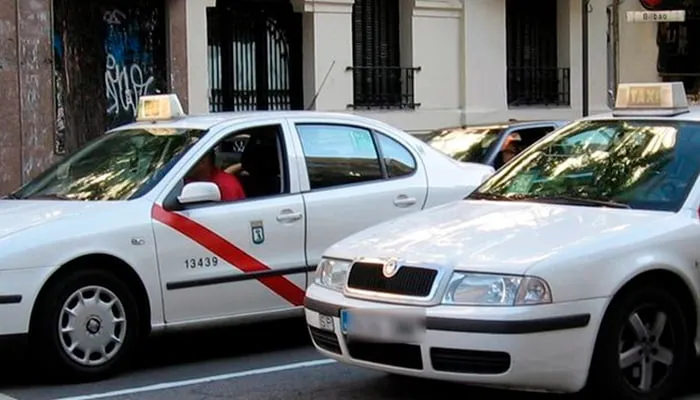
For decades, Madrid taxis were black with a red stripe. The switch to white, for practical reasons such as the heat or the resale of the cars, is one of the most visible changes of that period, and we tell the story in detail in the colour of Madrid's taxis.
The unified area with neighbouring towns
Previously, a Madrid taxi and one from a neighbouring town were restricted in where they could pick up passengers. The creation of a unified area, with towns such as Leganés, Pozuelo, Móstoles, Coslada, Alcorcón, Getafe and San Fernando joining, allowed taxis from all of them to work in that shared territory. This is the origin of today's joint service area, which has gradually taken in other towns over time. For travellers it means that a taxi can take them from the capital to those towns, and vice versa, under the same rules; airport prices from each town are on our taxi to towns in the Madrid region page.
What a professional taxi association does
Beyond its history, organisations such as the Federación Profesional del Taxi de Madrid carry out functions that affect taxi drivers and, indirectly, passengers:
- Representation before the authorities. Official fares are approved after consulting the sector's associations and consumer associations, and the same goes for changes to the taxi by-law. We explain that framework in the national taxi regulations.
- Services for members. Advice on paperwork, licence and vehicle formalities, tax and legal matters, insurance or training.
- Information and defence of the sector. Monitoring regulations, changes at the airport or competition from other transport services.
The federation is not the only one: several taxi associations coexist in Madrid, with different histories and outlooks. All of them are part of the history of a sector that has gone from the black cars of the transition years to a modern fleet; we tell the full story in how the taxi emerged and evolved in Madrid.
What remains of that era in your journey
When you get into a white taxi with a red stripe in Madrid today, in a city where taxis from the surrounding towns can work in a shared area and with fares approved after consulting the sector, you are seeing the result of changes that began to be negotiated in those years. Our airport transfers are carried out by official taxis licensed by Madrid City Council, and you can book your airport taxi with a fixed price by area: from inside the M-30, €33.
An official Madrid taxi to the airport
Book your transfer to Barajas in a taxi licensed by the City Council, with a fixed price and a 24-hour service.
Fixed fares
Airport taxi from your area
- Interior M-30 €33
- Torrejón de Ardoz €30
- Alcobendas €33
- San Sebastián de los Reyes Pueblo €33
- Alcalá de Henares €53
- Getafe €53
- Leganés €53
- Majadahonda €53
- Las Rozas de Madrid €58
- Móstoles €63
- Alcorcón €63
- Fuenlabrada €63
Need a taxi to the airport?
Instant fixed price. No sign-up.
- Journey
- When
- Your details
We can't find it on the list.
Call or message us and we'll give you a price straight away.
Terminal · Madrid-Barajas
Your fixed price
Passengers
Suitcases
Your fixed price
Booking received!
We'll confirm your booking by phone shortly. If it's for less than 2 hours from now, please call us directly.
Reference
Your fixed price