
The Royal Palace of Madrid, a must-see: what to see and how to plan your visit
History, unmissable rooms, gardens and practical tips for visiting the Royal Palace of Madrid without missing the best of it.
Published on 19 October 2016 Updated on 1 November 2026 5 min read
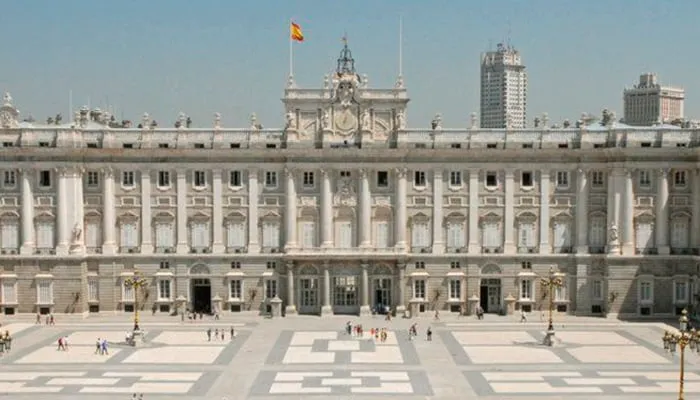
The Royal Palace of Madrid (Palacio Real) is the official residence of the Spanish Crown, one of the largest palaces in Western Europe and one of the city's must-see sights. Although the King and Queen live at the Palacio de la Zarzuela, the great state ceremonies are held here, and the rest of the time you can tour its historic rooms, the Royal Armoury (Real Armería) and the Royal Pharmacy (Real Farmacia). It stands in the centre, between the plaza de Oriente and the Almudena cathedral, and is managed by Patrimonio Nacional (the Spanish royal heritage agency).
A brief history of the Royal Palace
The site of the palace was first occupied by a Muslim fortress and later by the Real Alcázar of the Habsburgs. On Christmas Eve 1734 a fire destroyed the Alcázar, and Philip V decided to build in its place a palace worthy of the great European courts. The project was entrusted to the Italian architect Filippo Juvarra; on his death it was continued by his pupil Giovanni Battista Sacchetti, and Francesco Sabatini, architect to Charles III, took charge of the decoration and several extensions.
Charles III was the first king to live in it, and to decorate its ceilings he brought in the finest painters of the age, such as Giambattista Tiepolo, Corrado Giaquinto and Anton Raphael Mengs. Alfonso XIII was the last monarch to live there. If you would like to place the palace within the history of the city, we tell that story in historic Madrid: a journey back in time.
What to see inside the palace
The highlights of the visit
Main Staircase
A monumental marble staircase, the work of Sabatini, that welcomes you to the tour of the rooms.
Throne Room
Red velvet, mirrors, bronze lions and a vault painted by Tiepolo with an allegory of the Spanish monarchy.
Gasparini Room
One of the most ornate rooms, with rococo decoration on the walls, ceiling and floor, designed for Charles III.
Gala Dining Room
Where state banquets are still held, with a table that can seat dozens of guests.
Royal Armoury
One of the most important collections of arms and armour in the world, with pieces belonging to Charles V and Philip II.
Royal Pharmacy
A historic apothecary with ceramic jars and stills that supplied the royal family.
The palace also holds a collection of Stradivarius instruments, the Royal Chapel and numerous works of art. Next to the building is the Galería de las Colecciones Reales (Gallery of the Royal Collections), the museum that displays pieces from the Crown's collections; we include it in our round-up of Madrid's great museums.
Around the palace: squares, gardens and cathedral
- Plaza de la Armería: the great esplanade between the palace and the cathedral, with views over the Casa de Campo. This is where the formal changing of the Royal Guard takes place on the dates published by Patrimonio Nacional.
- Almudena Cathedral: Madrid's cathedral, opposite the south façade of the palace, consecrated at the end of the twentieth century after centuries of plans.
- Plaza de Oriente: with its statues of kings and the equestrian statue of Philip IV, opposite the Teatro Real.
- Jardines de Sabatini: a French-style garden beside the north façade, open to the public.
- Campo del Moro: the large garden that slopes down from the west façade towards the Manzanares, with the best view of the palace.
Both gardens also feature in our selection of Madrid's most beautiful parks and gardens.
Tips for visiting the Royal Palace
- Buy your ticket online on the Patrimonio Nacional website and check opening times, prices and free slots there, as they are updated.
- Check the calendar before you go. As a working palace, it may close fully or partly for official events.
- Allow a couple of hours for the rooms and the Royal Armoury, and a little more if you want to add the gardens.
- Go first thing to avoid the large groups, especially in high season.
- Combine it with the surroundings: the Plaza Mayor, the Templo de Debod and the Madrid de los Austrias (Habsburg Madrid) are a short walk away. Ideas in our guide to what to see in Madrid.
How to get to the Royal Palace by taxi
If you arrive in Madrid by plane, a taxi from any Barajas terminal to the area around the Royal Palace, or to your hotel in Ópera, Sol or La Latina, costs €33 with the inside the M-30 fixed fare, luggage included. During your stay, any taxi can drop you on calle Bailén, next to the entrance, or on the plaza de Oriente; the taxi in central Madrid page explains how to order one. If you are travelling as a large group, a 7-seater taxi lets you all travel together from the airport.
Staying near the Royal Palace?
Book your taxi from the airport to Ópera, Sol or La Latina for a fixed €33, at any time of the day or night.
Fixed fares
Airport taxi from your area
- Interior M-30 €33
- Torrejón de Ardoz €30
- Alcobendas €33
- San Sebastián de los Reyes Pueblo €33
- Alcalá de Henares €53
- Getafe €53
- Leganés €53
- Majadahonda €53
- Las Rozas de Madrid €58
- Móstoles €63
- Alcorcón €63
- Fuenlabrada €63
Need a taxi to the airport?
Instant fixed price. No sign-up.
- Journey
- When
- Your details
We can't find it on the list.
Call or message us and we'll give you a price straight away.
Terminal · Madrid-Barajas
Your fixed price
Passengers
Suitcases
Your fixed price
Booking received!
We'll confirm your booking by phone shortly. If it's for less than 2 hours from now, please call us directly.
Reference
Your fixed price