Discover the origin of the taximeter: from Rome to the flag-drop
From the odometer described by Vitruvius to Wilhelm Bruhn's taximeter: this is how the device that gave its name to the taxi and to the “flag-drop” was born.
Published on 28 July 2017 Updated on 1 November 2026 6 min read
The origin of the modern taximeter lies in Germany: it was invented by Wilhelm Bruhn in 1891, and a few years later, in 1897, the first motor taxi fitted with one took to the streets of Stuttgart. But the idea of measuring a vehicle's distance in order to charge for it is much older: the Roman architect Vitruvius had already described, in the first century BC, an odometer that counted the miles travelled using a system of gears and pebbles. Between the two lie centuries of hire carriages charging by guesswork, and of arguments about the price.
The Roman forerunner: a mile counter with pebbles
In his treatise on architecture, Vitruvius describes a mechanism for carts that worked like this: a toothed wheel attached to the axle turned with each revolution of the vehicle's wheel and very slowly moved a larger disc with holes in it. Each time the disc covered the equivalent of a mile, a small pebble dropped through a hole into a container. At the end of the journey, all you had to do was count the pebbles to know how many miles had been covered.
There is no evidence that it was used to charge passengers like a modern taxi, but the principle is the same one the taximeter would apply centuries later: turning the rotation of the wheels into a measure of distance. In ancient China, too, carts were built that marked distance with drumbeats.
Centuries of hire carriages without a meter
Vehicles for hire with a driver have existed in Europe's big cities for centuries: London's hackney carriages, the fiacres of Paris or the coches de punto of Madrid. For a long time, however, the price was set by time, by stages or simply by haggling, and complaints about overcharging were constant. Municipal authorities began publishing price tables, but without an instrument to measure the service, the argument remained between the coachman and the customer.
Throughout the nineteenth century, various devices were designed to record the distance travelled by carriages, although none caught on. Many coachmen were far from pleased at the idea of a machine keeping track of their earnings.
Wilhelm Bruhn and the “Taxameter”
The breakthrough came in 1891, when the German Wilhelm Bruhn developed the Taxameter, a mechanical device that calculated the fare from distance and time. Its name combines the word for “charge” or “tariff” with the Greek root for “measure”, and from there it passed into French as taximètre and into English as taximeter.
In 1897, the manufacturer Gottlieb Daimler built for the Stuttgart businessman Friedrich Greiner what is considered the first motor taxi with a taximeter. From then on, the combination of car and meter spread across European and American capitals within a few years, and the device ended up giving its name to the service itself: “taxi” is the shortened form of taximeter. If you are interested in the history of the word, we tell it in the origin of the word taxi.
| Period | Milestone |
|---|---|
| First century BC | Vitruvius describes an odometer for carts that counts miles with pebbles |
| Seventeenth to nineteenth centuries | Hire carriages in the big cities, with prices by time or haggled over |
| 1891 | Wilhelm Bruhn invents the Taxameter in Germany |
| 1897 | First motor taxi with a taximeter, in Stuttgart |
| Twentieth century | The mechanical flag taximeter becomes widespread and later goes electronic |
The flag that gave its name to the start of the journey
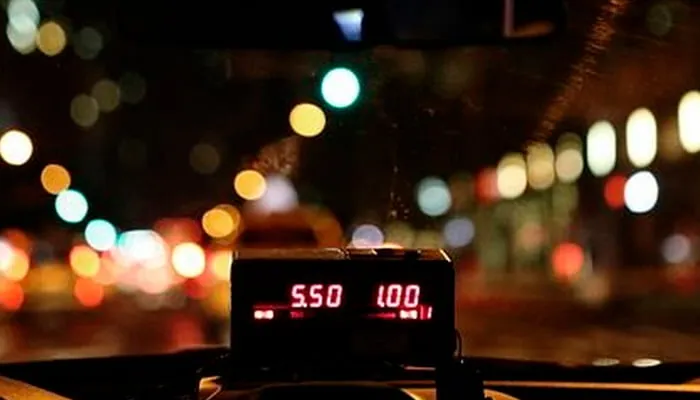
The first mechanical taximeters had a small metal flag on top. When the taxi was free, the flag was raised; when the customer got in, the driver lowered it by hand and that gesture set the clockwork mechanism going. That is where the expression “bajada de bandera” (flag-drop) comes from, which in Spain we still use for the fixed amount the meter starts at, even though no flag has been lowered for decades.
For much of the twentieth century, those mechanical devices were a feature of Madrid's first taxis; we describe what those cars were like in the first taxis in Madrid. Over time, the gear mechanism gave way to electronics.
From gears to electronics
Today's taximeter keeps Bruhn's logic, distance and time turned into money, but with electrical pulses, memory for several fares, a receipt printer and metrological checks that guarantee it measures correctly. We explain its parts and how it works in how a taximeter works, and how the service evolved alongside it in the history of the taxi and the taximeter.
More than a century later, the big change for travellers is not so much the device as the possibility of knowing the price before getting in. On transfers to Barajas Airport we work with a fixed price by area, with no meter: from inside the M-30 it is €33, and the other areas are on our airport fares page. You can book your taxi to Barajas days in advance or for the same day.
Prefer to know the price before you get in?
Book your airport taxi with a fixed fare by area and forget about watching the meter.
Fixed fares
Airport taxi from your area
- Interior M-30 €33
- Torrejón de Ardoz €30
- Alcobendas €33
- San Sebastián de los Reyes Pueblo €33
- Alcalá de Henares €53
- Getafe €53
- Leganés €53
- Majadahonda €53
- Las Rozas de Madrid €58
- Móstoles €63
- Alcorcón €63
- Fuenlabrada €63
Need a taxi to the airport?
Instant fixed price. No sign-up.
- Journey
- When
- Your details
We can't find it on the list.
Call or message us and we'll give you a price straight away.
Terminal · Madrid-Barajas
Your fixed price
Passengers
Suitcases
Your fixed price
Booking received!
We'll confirm your booking by phone shortly. If it's for less than 2 hours from now, please call us directly.
Reference
Your fixed price