Electric taxis: what they are like, their advantages and what changes for passengers
Quiet, fume-free and with a Zero emissions label: electric taxis are increasingly common in Madrid. We tell you what it is like to ride in one and what limits they still have.
Published on 24 January 2019 Updated on 1 November 2026 5 min read
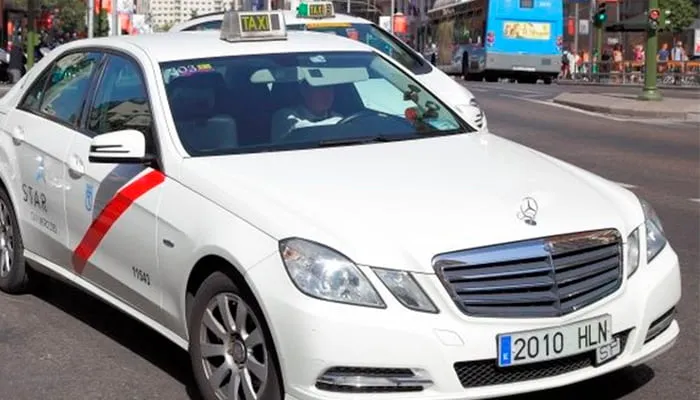
An electric taxi is a taxi that runs solely on an electric motor powered by batteries that are recharged by plugging it into the mains. For the passenger, the difference is noticeable as soon as it pulls away: it is quiet, accelerates smoothly and emits no exhaust fumes. It carries the DGT's Zero emissions label and is increasingly common in Madrid, where environmental rules and savings in day-to-day running have pushed many taxi drivers to make the switch.
Otherwise, an electric taxi is a taxi like any other: it has a licence, a meter and the official white livery with a red stripe, and it charges the same fares. You do not pay more to ride in one.
What it is like to ride in an electric taxi
- Silence: with no engine noise or vibration, it is easier to talk on the phone or rest.
- Smoothness: the electric motor delivers power progressively and without gear changes, which is welcome in city traffic.
- No smells: there are no fumes or fuel odours when you get in or out of the vehicle.
- Climate control while stationary: the car can keep the cabin at the right temperature while it waits without an engine running.
If you are interested in the details that make a journey more comfortable, we go through them in comfort and convenience for passengers.
Why there are more and more electric taxis
For a taxi driver, who may spend many hours a day behind the wheel, running costs matter a great deal. An electric car usually has a lower cost per kilometre than a combustion one, especially if it is charged at home or at off-peak times, and needs less maintenance: there are no oil changes, clutch or timing belt, and the brakes wear less thanks to regenerative braking, which recovers energy when slowing down.
Add to this Madrid's environmental rules, with low-emission zones, and taxi bylaws that have gradually required cleaner vehicles. We explain what each label means in Madrid's eco-taxis.
Electric, hybrid or combustion: the differences
| Electric | Hybrid | Combustion | |
|---|---|---|---|
| Energy | Rechargeable battery | Fuel and battery | Petrol, diesel or gas |
| Usual DGT label | Zero | ECO (or Zero for some plug-ins) | C or B, depending on age |
| Noise in the city | Very low | Low at low speeds | Normal engine noise |
| Refuelling | Recharging, slower than refuelling | Petrol station | Petrol station |
| Maintenance | Lower | Intermediate | Standard |
Hybrids, which combine a combustion engine and an electric motor, have for years been the most common vehicle among Madrid taxis and are still a very widespread option. We explain the different types in the trend towards hybrid cars, and why diesel has been losing ground in diesel, chronicle of a death foretold.
Range and charging: what still needs planning
The main limitation of an electric taxi is that recharging takes longer than refuelling. Taxi drivers get round this by charging at home overnight, using fast-charging points during breaks and planning their shifts. Today's batteries comfortably cover many urban journeys, although real-world range depends on the model, the temperature and the driving style.
For the passenger this makes hardly any difference. If you book a long journey, such as from a distant town in the Madrid region, we plan it in advance just like any other service.
Can an electric taxi take you to the airport?
Yes. A journey to Barajas Airport poses no problem for an electric taxi, and the boot of many models takes the usual luggage for a trip. If you are travelling with a lot of luggage or in a group, what matters is not the type of engine but booking a vehicle with enough space.
From the centre, the fixed airport fare from inside the M-30 is €33, whatever the vehicle. You can book your taxi to Barajas on the website or order it on WhatsApp; if you prefer a particular type of vehicle, mention it when booking and we will tell you whether it is possible.
Travel to Barajas at a fixed price
Official taxis licensed by Madrid City Council, to any terminal and at any time. Book for free and pay however you prefer.
Fixed fares
Airport taxi from your area
- Interior M-30 €33
- Torrejón de Ardoz €30
- Alcobendas €33
- San Sebastián de los Reyes Pueblo €33
- Alcalá de Henares €53
- Getafe €53
- Leganés €53
- Majadahonda €53
- Las Rozas de Madrid €58
- Móstoles €63
- Alcorcón €63
- Fuenlabrada €63
Need a taxi to the airport?
Instant fixed price. No sign-up.
- Journey
- When
- Your details
We can't find it on the list.
Call or message us and we'll give you a price straight away.
Terminal · Madrid-Barajas
Your fixed price
Passengers
Suitcases
Your fixed price
Booking received!
We'll confirm your booking by phone shortly. If it's for less than 2 hours from now, please call us directly.
Reference
Your fixed price